
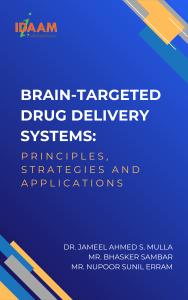
Brain-Targeted Drug Delivery Systems: Principles, Strategies, and Applications
(The book will be published with an ISBN)
Submit chapter abstract (250-300 words) along with table of content to books.idaampublications@gmail.com
About The Book:
The book is formatted to take the reader from the basic issues of drug transport to the brain thru to sophisticated delivery systems and their clinical application. Part I discusses the physiological and biochemical barriers to brain targeting. Part II discusses modern delivery strategies including nanocarriers, targeted delivery, gene and peptide therapeutics and noninvasive methods. Part III discusses the use of these systems for major neurological disorders . Part IV discusses the translational, regulatory and ethical aspects of CNS drug development. The book integrates theory, methodology and application to offer a comprehensive overview of brain-targeted therapeutics and the direction of the field.
Tentative Table of Contents:
Part I: Fundamentals of Brain Drug Delivery
Chapter 1:Introduction to Brain-Targeted Drug Delivery– Overview of CNS disorders and unmet clinical needs
– Challenges in CNS pharmacotherapy.- Chapter 2: The Blood–Brain Barrier and Blood–CSF Barrier: Structure and Function
– Mechanisms of drug transport and efflux
– Physiological barriers to CNS drug delivery - Chapter 3: Mechanistic Insights into Brain Drug Transport
– Receptor-mediated, carrier-mediated, and adsorptive-mediated transport
– Cellular uptake and intracellular trafficking
Part II: Strategies and Technologies for Brain-Targeted Delivery
Chapter 4:Nanotechnology-Based Approaches for Brain Delivery– Polymeric nanoparticles, lipid-based nanocarriers, dendrimers, and micelles
- Chapter 5: Liposomes, Exosomes, and Biomimetic Vesicles in Brain Targeting
- Chapter 6: Ligand- and Receptor-Mediated Targeting of the Brain
– Transferrin, insulin, lactoferrin, and other receptor pathways
Chapter 7:Intranasal Drug Delivery: A Noninvasive Route to the Brain- Chapter 8: Peptide and Protein-Based Drug Delivery Systems
- Chapter 9: Gene and Nucleic Acid Delivery to the CNS
– siRNA, mRNA, CRISPR-based systems
- Chapter 10:Stimuli-Responsive and Smart Delivery Systems for the Brain
– pH-sensitive, magnetic, and ultrasound-assisted approaches
Part III: Applications in Neurological and Neurodegenerative Disorders
Chapter 11:Targeted Drug Delivery for Alzheimer’s and Other Dementias- Chapter 12: Nanocarrier-Based Therapies for Parkinson’s Disease
- Chapter 13:Advances in Brain Tumor Drug Delivery Systems
- Chapter 14: Brain-Targeted Delivery for Epilepsy and Psychiatric Disorders
- Chapter 15: Neuroinflammation and Neuroprotection: Emerging Drug Delivery Approaches
Part IV: Translational and Regulatory Perspectives
- Chapter 16: Pharmacokinetics and Biodistribution of Brain-Targeted Systems
- Chapter 17: Preclinical and Clinical Evaluation of Brain Delivery Platforms
- Chapter 18: Regulatory and Ethical Considerations in CNS Drug Delivery
- Chapter 19:Manufacturing, Quality Control, and Scalability of Advanced Drug Delivery
Systems
- Chapter 20: Future Directions and Emerging Trends in Brain-Targeted Therapeutics
[Note: Strikethrough chapters (1, 4, 7, 11) are already taken by other authors].
About Editors:

Dr. Jameel Ahmed S. Mulla
Professor & Head,
Department of Pharmaceutics,
Shree Santkrupa College of Pharmacy, Ghogaon-Karad, MS, India

Mr. Bhasker Sambar
Sr. Manager,
External R&D and Technical Services
Alvogen Inc.,NJ, USA

Mr. Nupoor Sunil Erram
Principal,
Shivsamarth College of Pharmacy, Talmavale, Maharashtra, India
Important Dates:
• Abstract Submission: by 31ˢᵗ August 2026
• Full Chapter Submission: by 15ᵗʰ October 2026
Chapter Processing Charge (CPC):
A Chapter Processing Charge (CPC) is required to cover the costs of typesetting, processing, and global online hosting. All corresponding authors will be asked to pay their publication charges upon acceptance of abstract as Chapter Processing Charge –
USD 100 (for overseas authors), INR 3000 (for authors from India) per published chapter (Maximum 3 Authors per Chapter).